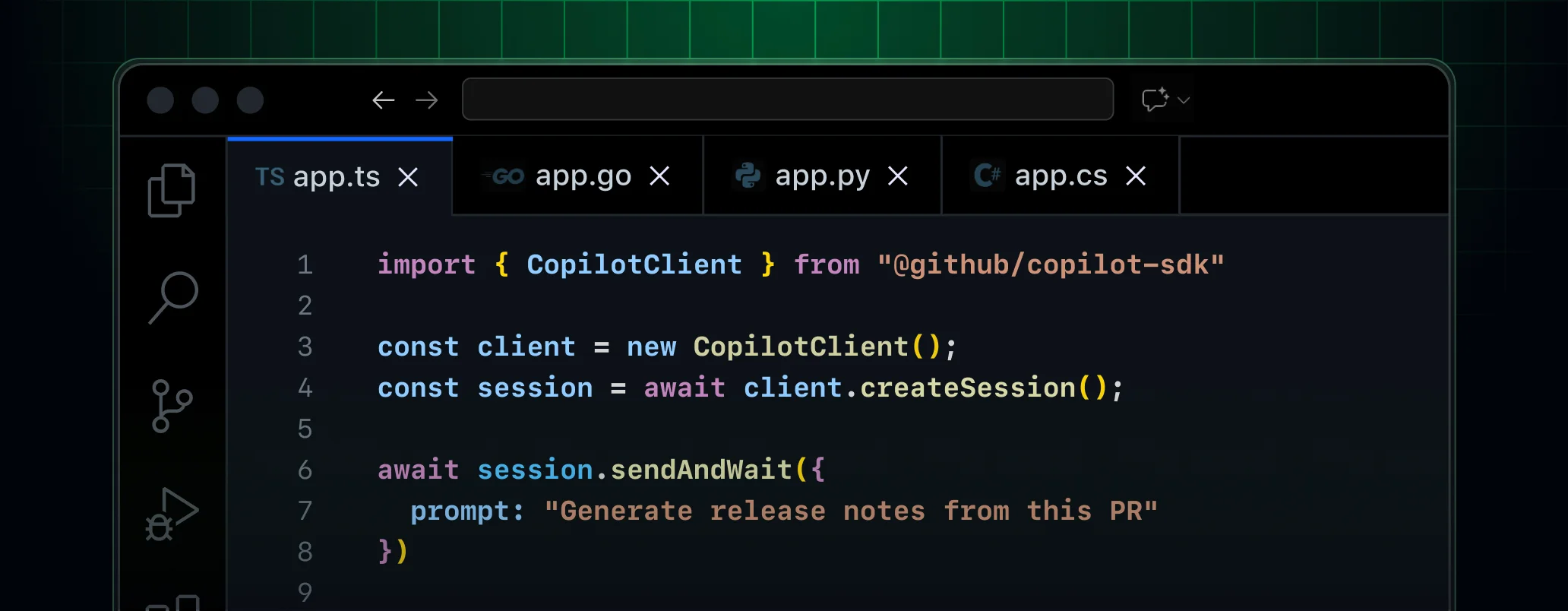
GitHub has taken another step toward turning AI-assisted development into something teams can actually build on. With the public preview of its Copilot SDK, the company is no longer talking only about a chat box, a sidebar, or even a standalone coding agent. It is exposing the runtime behind those experiences as a programmable layer that developers can embed into their own products, workflows, and internal tooling.
That shift matters because the conversation around AI coding has moved well beyond autocomplete. For the last two years, the industry has been asking a harder question: what happens after the model writes the first draft? The answer has increasingly been about orchestration — deciding when an agent should plan, when it should call tools, when it should pause for approval, and how its work should be traced, reviewed, and audited.
The new SDK is GitHub’s clearest attempt yet to productize that orchestration layer. In practical terms, it gives developers a way to embed Copilot-style agentic behavior directly into their own applications rather than sending users out to a separate workflow. GitHub says the SDK is now available in public preview and supports Node.js, Python, Go, .NET, and Java. That wide language coverage is not a cosmetic detail. It signals that GitHub wants the SDK to feel like infrastructure, not an experiment.
From product feature to programmable runtime
The most important idea in the launch is not the number of languages or the list of install commands. It is the fact that GitHub is exposing the same runtime that already powers Copilot CLI and Copilot cloud agent. That means the company is betting that the value is not only in the model itself, but in the surrounding machinery: planning loops, file edits, tool invocation, multi-turn sessions, and the permission scaffolding that keeps those sessions under control.
For developers, this changes the mental model. Instead of asking, “How do I prompt the model better?” the more useful question becomes, “What do I want this agent to be able to do, and under what constraints?” That is a more operational way to think about AI assistance. It is also more honest. Real software teams do not need a chatbot that sounds smart; they need a system that can be trusted to inspect files, propose changes, respect boundaries, and leave a trail that humans can review.
GitHub’s preview points in that direction. The SDK exposes building blocks for custom tools and custom agents, which lets teams define domain-specific actions rather than relying on generic behavior. It also supports streaming responses, blob attachments, and OpenTelemetry tracing, which are all strong signals that the company expects these agents to operate inside real production systems, not just sandboxes.
Why this matters for AI-assisted development
There is a broader pattern here that is easy to miss if you focus only on the launch announcement. The first wave of AI coding tools was mostly about individual productivity. The pitch was simple: write less boilerplate, generate faster, spend less time on repetitive work. The second wave is about workflow control. The question is no longer whether an assistant can generate code, but whether it can participate safely in the engineering process itself.
That distinction matters for teams because the costs of AI are no longer limited to mistakes in generated code. They also include ambiguity about ownership, hidden prompts, missing context, and brittle integrations that are hard to observe once deployed. A serious SDK has to solve for those problems. GitHub’s emphasis on permissions, tool boundaries, and tracing suggests that it understands the market is moving from novelty to governance.
There is also a business implication. If the SDK is good enough, organizations will not just use Copilot inside GitHub products. They will start building their own task-specific agents for support flows, code review automation, issue triage, incident response, documentation updates, and internal developer portals. In other words, AI coding stops being a feature you buy and becomes a layer you compose.
What the SDK exposes to builders
GitHub highlights several capabilities that help explain where this is headed. Custom tools and custom agents let teams model their own domain. Fine-grained prompt customization gives builders a way to adjust sections of the system prompt without rewriting the whole thing from scratch. Streaming makes the experience feel responsive. Blob attachments make it easier to hand agents screenshots or binary inputs. OpenTelemetry helps tie agent activity back to the rest of an application’s observability stack. And the permission framework makes it possible to block sensitive operations or exempt read-only actions from unnecessary approvals.
Perhaps the most important detail for enterprises is bring-your-own-key support. That matters because many organizations are not looking for yet another black box account relationship. They want control over model choice, billing, and policy. The SDK’s BYOK support makes it easier to fit agentic workflows into existing procurement and compliance models instead of forcing everyone into a single vendor path.
The downside is that this also raises the bar for engineering discipline. Once you embed an agent into a product or workflow, you inherit all the familiar responsibilities of software design: lifecycle management, failure handling, security reviews, rate limits, logging, and rollback planning. A coding agent that can act is more powerful than a coding assistant that can only suggest, but it also needs to be treated more like a service than a toy.
The real story: orchestration is becoming the product
That is why this release feels important even beyond GitHub’s ecosystem. It reflects a larger industry transition. The market is slowly realizing that the model is only one part of the system. The real advantage comes from the surrounding orchestration layer: tool use, memory boundaries, approval flows, auditability, and the developer experience for controlling all of that.
For AI-assisted development, that is good news. It means the conversation is maturing. Teams are moving away from broad claims about replacing engineers and toward practical questions about how to make engineers more effective without losing control of the codebase. A good SDK can help with that by turning vague AI capability into something measurable, composable, and governable.
GitHub’s Copilot SDK does not solve every problem in AI coding, and it is still only in public preview. But it does mark a useful boundary in the market. The era of asking whether agents can write code is over. The next phase is about whether they can be embedded into the engineering stack in a way that developers trust. That is the harder problem — and the one that matters more.