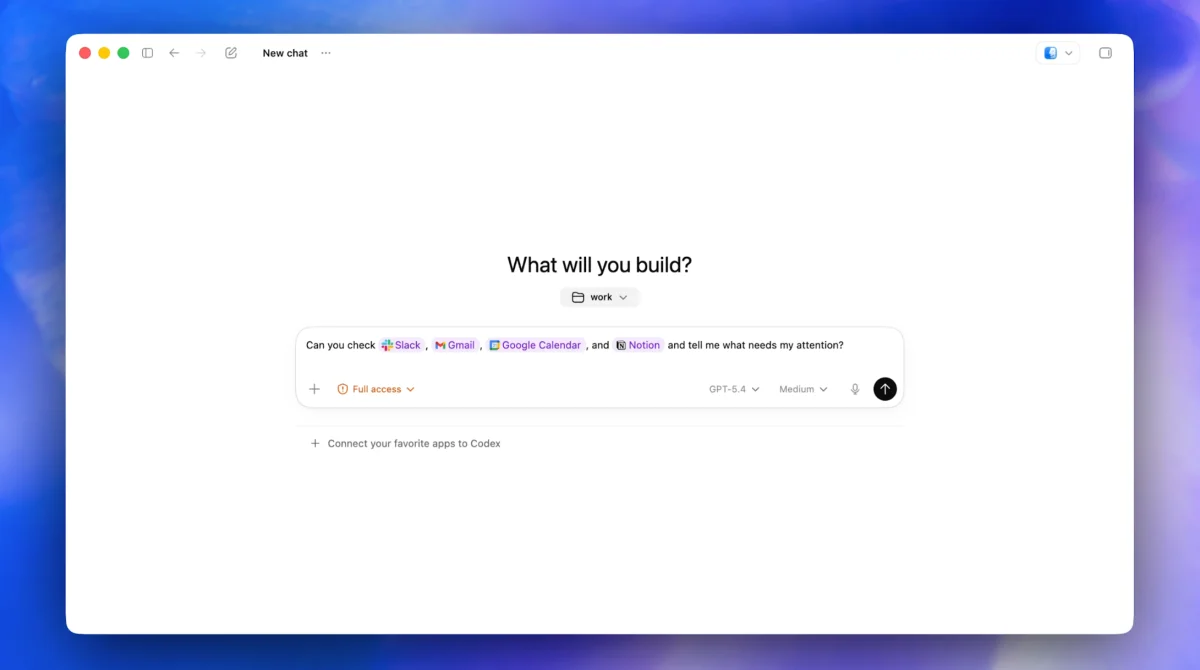
OpenAI’s latest Codex update signals a shift that matters far beyond a single product release: AI coding tools are moving from suggestion engines inside the editor to agents that can take on bigger chunks of the software workflow. The headline change is not just better code generation. It is broader operational reach.
That is the real inflection point for teams trying to understand where AI-assisted development is going next. For the last two years, the dominant pattern has been autocomplete, chat, and small in-editor edits. Useful, yes. But still bounded by the interface of the IDE. The new direction is different. The agent is being positioned as something that can work across the desktop, cross app boundaries, and take on longer-running tasks instead of only reacting to a prompt in place.
That matters because once an assistant can move beyond the editor, the discussion changes from “How good is the code?” to “How safely can the system operate?” A coding agent with more reach needs better permissions, stronger review loops, clearer logging, and more disciplined rollback paths. If it can inspect, change, and coordinate across tools, then the engineering challenge becomes one of control as much as generation.
What changes when the agent reaches the desktop
Desktop-level control turns a coding tool into a workflow tool. In practice, that could mean the agent can move from reading a task description to checking files, adjusting implementation details, validating results, and continuing through adjacent applications without a human re-entering every step. That is appealing for routine work, especially when teams want to offload repetitive coding chores.
But desktop reach also raises the bar for trust. A tool that can cross boundaries can also cross the wrong ones if guardrails are weak. Teams will need to think about what the agent is allowed to see, what it can modify, when it must ask for confirmation, and how its actions are audited afterward. The difference between a helpful assistant and an expensive mistake may come down to whether the agent is operating inside a tightly scoped sandbox or a loosely managed workstation.
For software leaders, this is the part of the story worth watching closely. The industry has already learned that model quality alone does not solve production adoption. The harder part is operationalizing the system so that the output is dependable, reviewable, and safe enough for real use.
Why this is bigger than another feature update
There is a strategic shift underneath the product news. AI coding is no longer being marketed only as a faster way to type. It is becoming a layer that can participate in the delivery process itself. That changes how buyers evaluate the tool. The question is no longer whether it saves minutes in the editor. The question is whether it can reduce cycle time across the full path from task intake to verified change.
That also means the competitive frontier is moving. The most interesting products in this space are converging on a similar promise: plan, edit, run, verify, and hand off. Once that happens, vendors stop competing only on autocomplete quality and start competing on workflow depth, permission models, and the degree of confidence they can create for engineering teams.
OpenAI’s move suggests that the company wants Codex to feel less like a chat window and more like a task executor. If that trajectory holds, expect the next round of product debates to focus on approval flows, desktop safety, tool routing, and the ability to keep the agent useful without making it overly permissive.
What engineering teams should do now
- Scope access narrowly. Give the agent only the files, services, and credentials it actually needs.
- Instrument the workflow. Keep logs of prompts, actions, and outputs so every change is traceable.
- Separate generation from release. Let the agent draft and execute, but keep human review in the approval path.
- Test failure modes. Assume the agent will eventually misread a task, touch the wrong file, or overreach.
- Measure outcomes, not novelty. Track whether the tool really improves throughput, quality, and developer satisfaction.
The big signal here is simple: AI coding tools are graduating from “assistant in the editor” to “operator across the workflow.” That may be the most important shift in developer tooling this year, because it changes both the upside and the risk profile at the same time.