Notion is no longer positioning itself as just a place for notes, docs, and project pages. With its new Developer Platform, the company is trying to become the place where humans, coding agents, and external systems actually coordinate work.
The biggest shift is not the branding around AI. It is the plumbing behind it: a hosted runtime for custom code, a way to connect external agents, a CLI made for developers and coding agents, and workflow triggers that can move data in and out of Notion without a pile of glue code.
That matters because most AI productivity demos break down at the same point. A model can draft a message or summarize a page, but real work also needs authentication, permissions, repeatable logic, auditability, and reliable access to internal data. Notion’s answer is to move those responsibilities into infrastructure that teams can control.
At the center of the announcement is Workers, Notion’s hosted environment for custom code. Instead of forcing teams to spin up their own services for every integration, Workers let developers write logic that syncs data, builds agent tools, and reacts to events from other apps. In theory, that makes Notion less of a destination app and more of an orchestration layer.
The company is also opening the door to external agents. According to the announcement, teams will be able to bring in tools such as Claude, Codex, Decagon, or custom agents they build themselves. That is a notable design choice: Notion is not trying to replace every agent model, but to sit above them as the shared workspace where agent work gets coordinated.
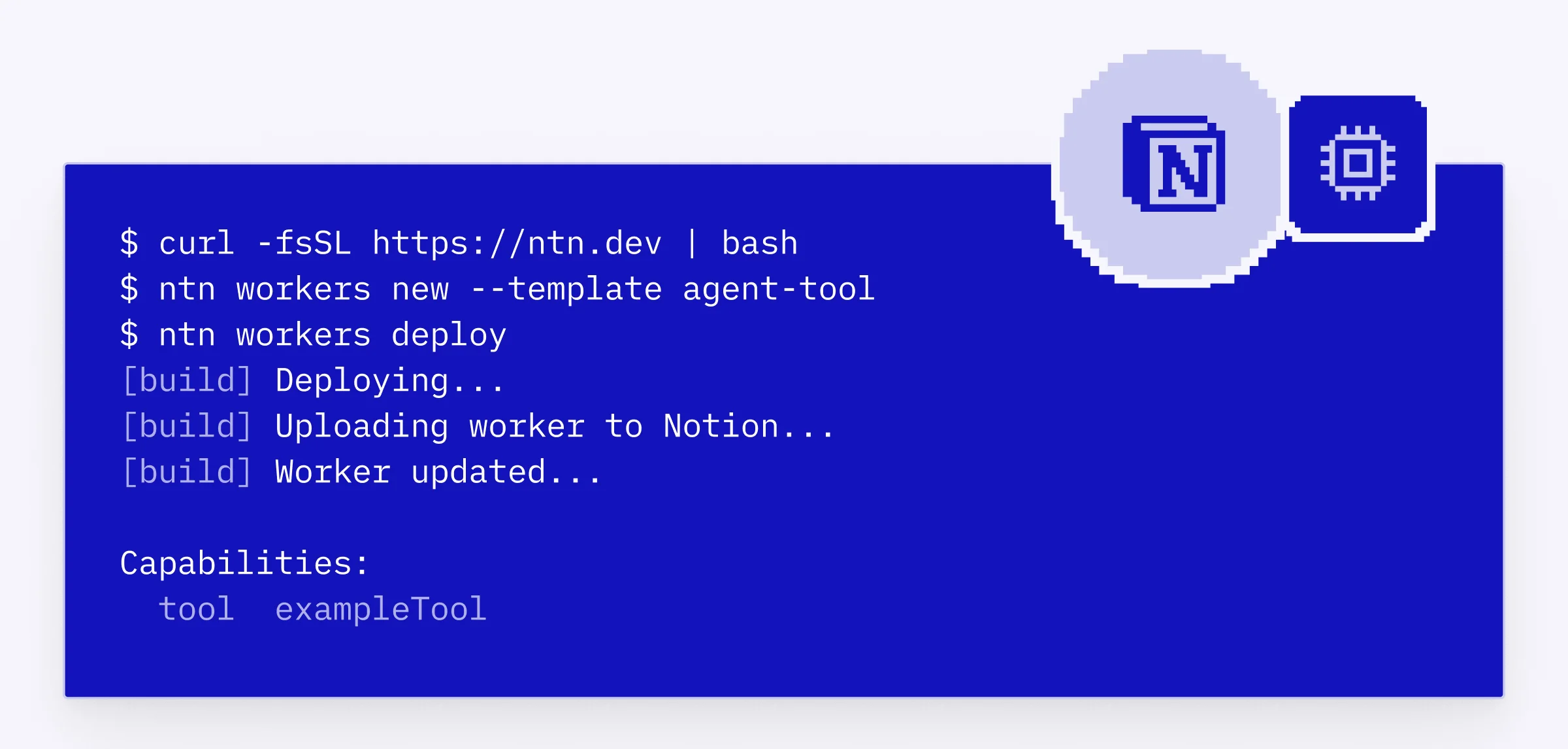
For developers, the most interesting piece may be the CLI. Notion says it built the command-line interface specifically for developers and coding agents, with support for signing in, reading and acting on workspace content, and deploying Workers. That is the kind of detail that signals a product moving from consumer-friendly AI features toward actual developer infrastructure.
There is also a broader market signal here. Enterprise AI software is increasingly converging on the same question: where does deterministic code end and model reasoning begin? The winners are likely to be the systems that let teams use the model for judgment while keeping the business logic, routing, and safeguards in code.
Notion seems to be betting that the future of productivity software is not a chat box attached to a document editor. It is a workspace that can host agents, execute logic, pull in data from other systems, and let teams see the whole workflow in one place.
If that bet pays off, Notion will be competing less with note-taking apps and more with the platforms that sit between SaaS tools, internal databases, and the AI agents now starting to mediate real work.