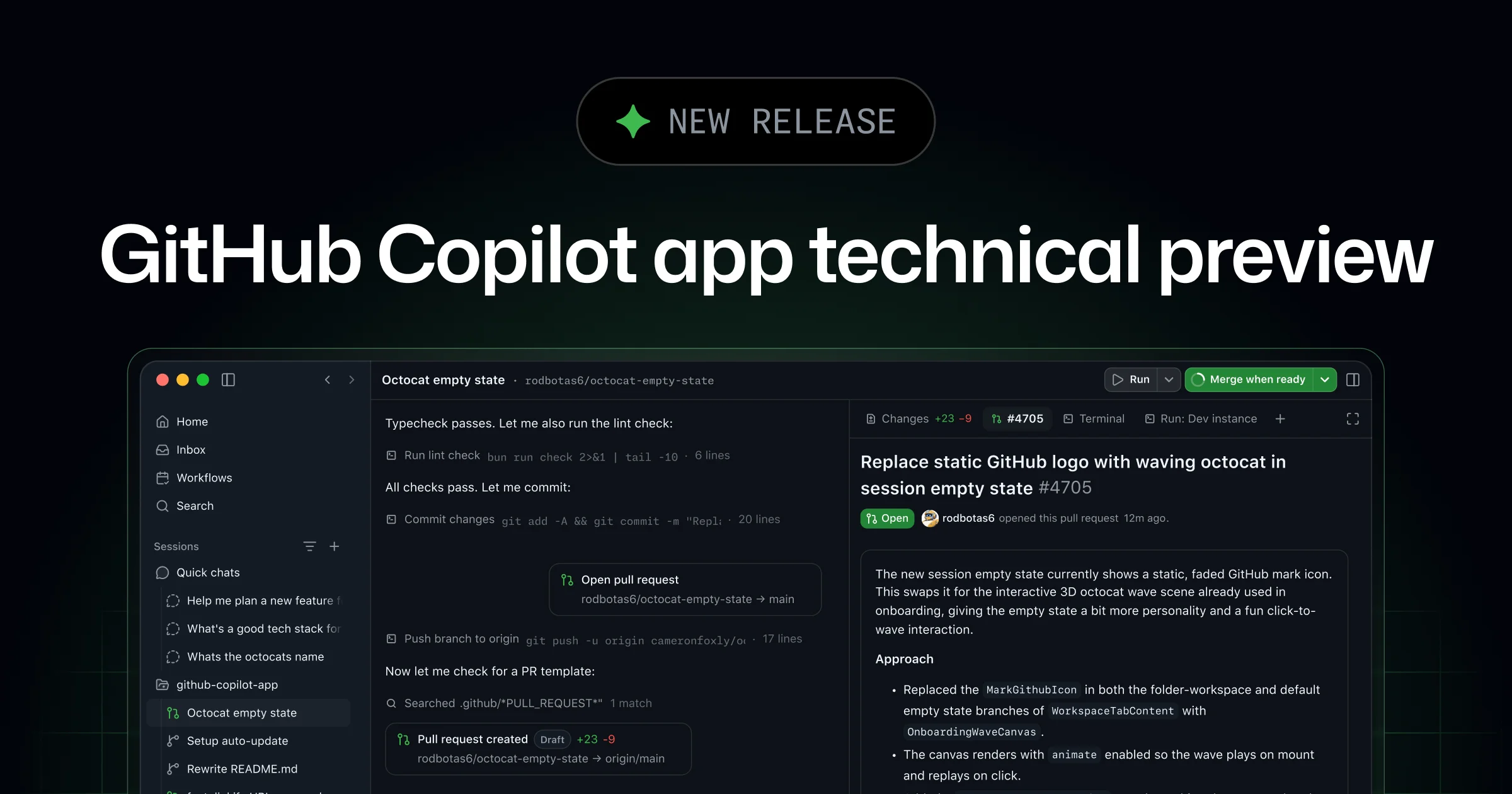
GitHub has pushed Copilot one step farther away from a browser tab and one step closer to being a real operating environment for software work. In a technical preview announced on May 14, the company introduced the GitHub Copilot app, a GitHub-native desktop experience designed to start agentic development from the work already in front of you, keep that work isolated, and carry it through review and merge.
That framing matters because the center of gravity in AI-assisted development keeps shifting. The first wave was autocomplete. The second was chat inside the IDE. The current wave is about task execution: starting from an issue, pull request, prompt, or previous session, then letting an agent take on a bounded piece of work while the developer stays in control. GitHub’s new app is a clear attempt to make that workflow feel native rather than bolted on.
GitHub is treating the session as the unit of work
The biggest design choice in the preview is not a model choice or a benchmark claim. It is the unit of organization. According to GitHub, each session has its own branch, files, conversation, and task state. That means the agent is no longer just a sidebar that answers questions about code. It becomes a structured workspace that can be paused, resumed, and kept separate from other tasks.
That matters for real teams. The pain point with agentic coding is rarely the first generation of code. It is the management overhead after that: where the work lives, how changes stay isolated, how review comments map back to intent, and how a developer returns to the task the next day without re-creating the context from scratch. GitHub is trying to solve that by making the session itself portable and reviewable.
Why the preview is strategically important
GitHub is also making a broader argument about where AI-assisted development is headed. The company is not positioning Copilot as a better autocomplete product. It is positioning it as a place to start from GitHub context, work in focused sessions, and ship through the same pull request process teams already trust. In other words, the value proposition is not just code generation. It is orchestration.
That is a meaningful shift for software organizations that have already adopted Copilot in editors and terminals. Once an agent can start from the issue, stay isolated, and return a reviewed diff, the practical conversation changes from “Can the model write code?” to “Can the system safely manage work from request to merge?”
The preview also broadens access patterns. GitHub says Copilot Pro and Pro+ subscribers can sign up for early access as the technical preview expands, while Business and Enterprise access will roll out over time. That rollout path suggests the company sees the app not as a novelty feature but as part of its enterprise AI surface area.
What developers should read between the lines
The app’s feature list is revealing because it reflects what GitHub thinks developers actually need from an agentic workflow. The announcement emphasizes start points like issues and pull requests, isolated workspaces, validation tools, browser access, and a path back to the pull request review loop. Those are all signs that the company is trying to move the toolchain from “ask and hope” to “inspect, steer, and verify.”
That also puts GitHub in a different competitive lane from pure code completion vendors. The contest is no longer only about model quality or how well a chatbot can explain a function. It is about whether the surrounding product can safely coordinate multi-step work across repos, branches, checks, previews, and review comments. The winner will be the platform that reduces the amount of manual glue work developers still have to do.
There is also a subtle cultural message here. By making sessions first-class, GitHub is acknowledging that AI-assisted development is becoming task-based rather than prompt-based. A prompt may kick off the work, but the real product is the lifecycle around it: state, review, validation, and closure. That is a much closer match to how professional software teams actually operate.
The broader signal for the market
Seen alongside the wider shift in the market, the Copilot app preview reinforces a trend that has become hard to ignore: AI coding tools are moving from features inside existing editors to dedicated orchestration surfaces. The race is no longer just to place a model closer to the cursor. It is to build a system that can hold context, respect boundaries, and produce reviewable output inside the collaboration tools teams already use.
For developers, the practical takeaway is simple. Agentic coding is increasingly being designed as a workflow, not a trick. That should make the technology easier to adopt in serious environments, but it also raises expectations. If the session is the unit of work, then debugging session state, governance, permissions, and review quality become part of the product promise.
GitHub’s preview does not settle that debate. It does, however, make the direction of travel obvious: the next phase of AI-assisted development will be judged less by flashy demos and more by whether the agent can stay organized, stay isolated, and stay useful from the first issue to the final merge.