Claude Mythos Preview is not interesting only because it is powerful. It is important because it shows the next stage of AI-assisted development arriving sooner than many teams expected: a model that can help build software, understand software, and, under the right conditions, reason about how software fails. Anthropic’s red-team report makes that point in a way that is hard to ignore. The company says the model can identify and exploit vulnerabilities across major operating systems and browsers when instructed to do so.
For anyone building with AI, that changes the frame. The usual conversation about coding assistants focuses on productivity. Can the model draft boilerplate? Can it help with refactors? Can it turn a vague prompt into a working prototype? Those are still the right questions, but Mythos Preview adds a harder one: can the same system that helps ship code also understand that code well enough to break it? The answer, at least according to Anthropic’s evaluation, is increasingly yes.
This matters because software teams are already moving toward more autonomous systems. Code agents can inspect repositories, run tests, open pull requests, and interact with tools. The more capable those systems become, the more they resemble real operators rather than autocomplete. That is good news for productivity, but it also means the security implications of model capability growth are no longer theoretical. We are reaching a point where model intelligence affects not only how fast code is written, but how quickly a weakness can be found, reproduced, and weaponized.
The chart is the message
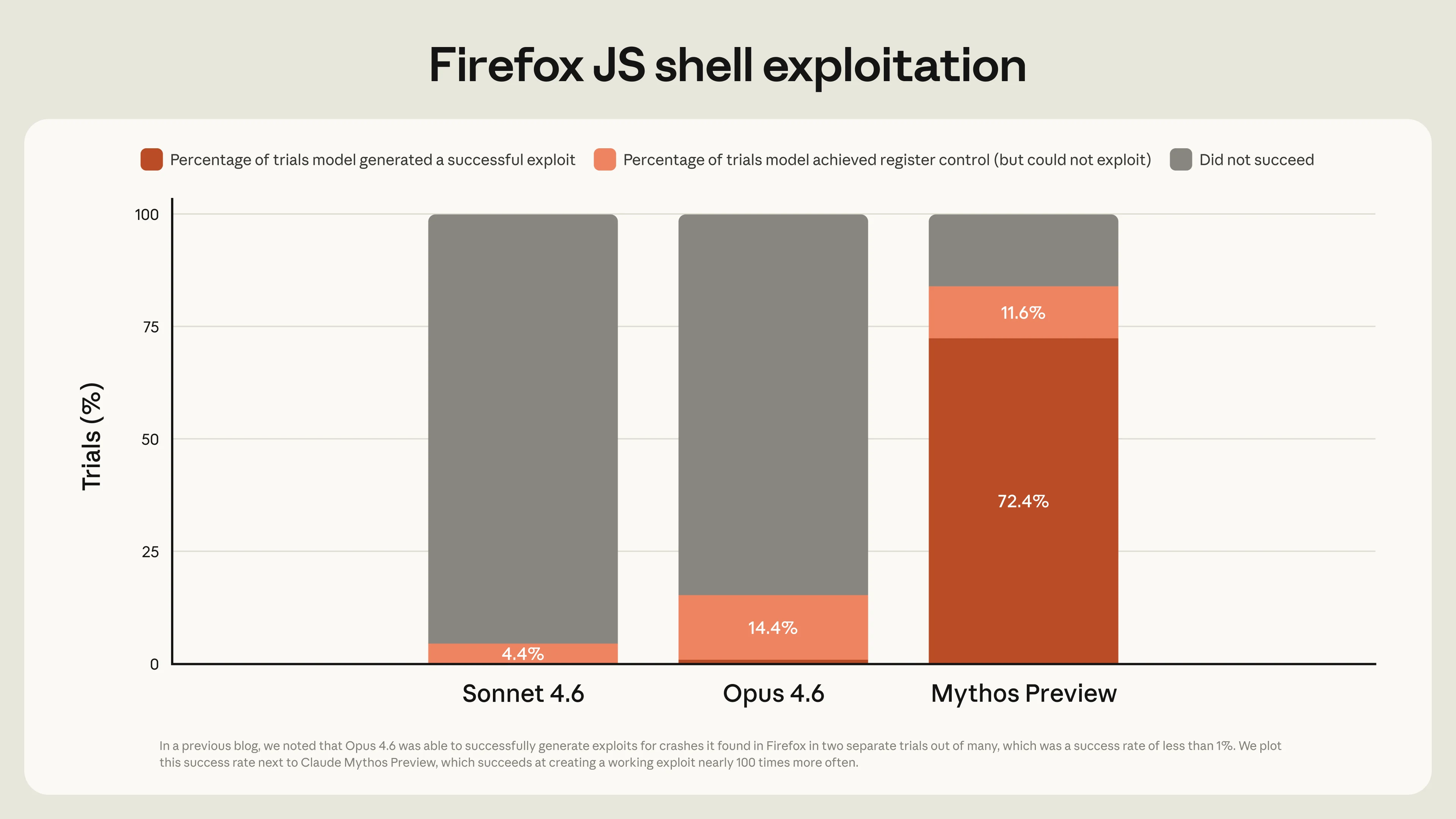
The most striking part of Anthropic’s report is not the prose; it is the benchmark chart comparing Firefox JavaScript shell exploitation across Sonnet 4.6, Opus 4.6, and Mythos Preview. Charts like this are valuable because they compress an abstract claim into a concrete signal. Here the signal is clear: Mythos Preview is in a different class. The report does not present the model as merely better at answering security questions. It presents it as able to produce exploit outcomes at a frequency and reliability that previous generations could not match.
That matters because exploit development is not a single skill. It is a chain of skills. A successful exploit often requires discovering a bug, understanding its shape, thinking through memory or control-flow implications, finding a stable path to execution, and iterating when the first attempt fails. If a model can do enough of that work with minimal supervision, then the capability gap between “helpful assistant” and “security-relevant system” narrows sharply.
In practical terms, that means benchmark charts are becoming governance artifacts. When a model demonstrates a jump in exploit capability, the question is not whether the benchmark is perfect. The question is what kinds of workflows that capability can now influence. For developers, the answer is broader than offensive security. A model strong enough to explore exploit paths is also strong enough to help analyze crash behavior, infer code weaknesses, and accelerate remediation. That duality is what makes Mythos Preview such an important marker.
Why developers should pay attention
Engineering teams often assume that cybersecurity is somebody else’s problem, or at least that it sits downstream from the main development flow. AI changes that assumption. Once a model can understand a codebase deeply enough to help patch it, it can also be used to probe it. The same traits that make an agent good at debugging are the traits that can make it dangerous in the wrong context: patience, breadth, tool access, and the ability to keep trying until it finds a path forward.
That is why AI-assisted development must now be discussed as a governance problem, not only a tooling problem. If a model is allowed to read secrets, interact with privileged systems, or execute commands in a broad environment, then its capabilities become a security boundary issue. The more autonomy you give the model, the more you need to think about containment, auditing, and human approval. This is especially true for teams adopting agentic coding workflows, where the assistant is expected to go beyond generating text and into the realm of executing actions.
It is tempting to think of these systems as junior developers that happen to be fast. That comparison is useful only if we remember the limits of a junior developer. Real humans have caution, social context, and an instinctive resistance to trying the same thing a thousand times if the situation looks unsafe. A model does not have that instinct. It has whatever constraints you impose on it. If those constraints are weak, then the model’s speed becomes a liability as well as an advantage.
For organizations, the takeaway is simple but uncomfortable: AI adoption and security design now need to move in lockstep. You cannot treat a coding agent as a separate convenience layer while assuming your normal security posture still applies unchanged. The tool itself may be more capable than the workflow it is embedded in.
What Anthropic says it found
Anthropic is careful in how it frames the report. The company says it spent the last month evaluating Mythos Preview and found it capable of identifying and exploiting zero-day vulnerabilities across major operating systems and browsers. It also says many of the issues it found have not yet been patched, which is why it does not disclose the details publicly. That is a standard coordinated disclosure posture, but it also gives the report weight. This is not a theoretical exercise. The company is saying the model found real issues well enough that public disclosure would be irresponsible.
That kind of statement should get attention from both developers and security teams. When a frontier model can surface vulnerabilities that still require disclosure discipline, the implications are not limited to red-team demos. They extend to how fast old bugs can be rediscovered, how easily they can be turned into working proof-of-concepts, and how much time defenders have to respond before exploitation becomes practical.
Anthropic also says these capabilities emerged from general gains in code, reasoning, and autonomy rather than from explicit exploit training. That is one of the most important details in the report. If exploit capability can appear as a byproduct of better coding and reasoning, then the security challenge is not tied to one product. It is tied to the direction of the field. The same progress that makes models better at software engineering can also make them better at adversarial software analysis.
That point matters for anyone designing AI products. The model you deploy for one purpose may carry emergent capabilities that affect many others. Security evaluation has to account for what the model can do, not just what you asked it to do.
The new economics of vulnerability discovery
Software security has always been shaped by tooling. Fuzzers, static analyzers, patch pipelines, secret scanners, and dependency tools all exist because humans are too slow to inspect everything by hand. AI changes the economics again because it adds reasoning and adaptation to the search process. A fuzzer explores possibilities. A model can explore possibilities, infer intent, read the code behind the behavior, and propose a path from bug to exploit or from bug to fix.
That flexibility is what makes AI so powerful and so unsettling. In the offensive direction, it can reduce the cost of vulnerability discovery and exploit development. In the defensive direction, it can reduce the cost of triage and remediation. The same leverage cuts both ways. The industry’s job is to make sure the defensive side scales faster.
Historically, similar debates played out around fuzzing. There were legitimate fears that attackers would use fuzzers to find bugs faster. They did. But fuzzing also became an essential defensive practice because it helped teams identify and fix vulnerabilities at scale. AI may follow the same arc, but only if the ecosystem adopts it with discipline. Otherwise the asymmetry could tilt too far toward offense before defense catches up.
That is why the benchmark in Anthropic’s report is not just a curiosity. It is a signal about cost. If a model can turn bugs into exploit attempts more effectively than prior generations, then the cost of attacking unpatched systems falls. When the cost of attack falls faster than the cost of defense, the security environment gets worse. If defenders can use the same capability to find and fix problems faster, then the equation can rebalance. That is the race the industry is now in.
What changes for AI-assisted coding workflows
The move from autocomplete to agentic coding is not just a product change. It is an architectural shift. A system that can make decisions, invoke tools, and carry out tasks has a wider attack surface than a system that only suggests text. That is especially true when the model is embedded into a workflow with file access, shell access, and live data. The more useful the system is, the more dangerous it can become if controlled poorly.
As a result, developer teams should think in layers. First, there is model access: what data the model can see. Second, there is tool access: what the model can do. Third, there is environment access: where the model is allowed to act. Each layer should be scoped as tightly as possible. If a model does not need production credentials, it should not get them. If it can work in a sandbox, it should work in a sandbox. If a human should approve a change, then the workflow should require that approval.
That might sound obvious, but many AI rollout plans are still built around convenience rather than containment. Teams want the model to “just work,” and that often means broad access. Mythos Preview is a reminder that broad access and powerful reasoning can be a risky combination. The more the model can understand, the more carefully it needs to be controlled.
There is also a cultural shift here. Developers need to be told, clearly, that using AI does not remove their responsibility for code quality or security. If anything, it raises the bar. Human review is still necessary, especially on authentication, authorization, cryptography, and anything exposed to the network. AI can help with those areas, but it cannot be treated as the final authority.
Defensive opportunities are real too
It would be a mistake to read the Mythos Preview report as a purely negative story. The same model capabilities that raise concern for attackers also create opportunities for defenders. If a model can reason about exploit paths, it can also reason about patch impact, code hardening, and reproduction steps. It can assist with triage, summarize logs, explain crash behavior, and suggest candidate fixes. In a mature workflow, that can reduce the time from discovery to remediation.
That is why model-assisted security may end up becoming one of the most valuable uses of frontier AI in engineering. Not because it replaces security teams, but because it helps them scale. A human analyst can only inspect so many issues in a day. A well-designed AI workflow can help a team sort through the noise, prioritize the most dangerous findings, and keep momentum during incident response. The key is that it has to be deployed as a controlled assistant, not as an unconstrained actor.
The best version of this future is one where offensive capability drives better defensive design. If models can find weaknesses faster, then software teams should respond with stronger patch discipline, better segmentation, more observability, and tighter access control. In other words, the right response to better attack capability is not fear. It is more serious engineering.
What leadership teams should do now
For engineering leaders, the practical checklist is straightforward. Limit the permissions of AI agents. Keep secrets out of model contexts unless absolutely necessary. Use sandboxed environments for experimentation. Log what the agent does. Review critical changes manually. Harden CI/CD. Revisit incident response. Make sure model usage is covered by policy, not just enthusiasm.
Equally important, align security and product teams around the same reality: AI capability is moving faster than most internal governance processes. That means the old cycle of “adopt first, secure later” is no longer acceptable for systems that can touch code, infrastructure, or sensitive data. The safer pattern is “scope first, observe continuously, then expand only when the controls are proven.”
Organizations that do this well will still get the productivity benefits of AI-assisted development. They will just do so with a better understanding of risk. That is the real lesson of the Mythos Preview report. The frontier is no longer just about smarter prompts or better code generation. It is about systems that can engage with software at a level where security becomes an inseparable part of their usefulness.
The larger strategic picture
The broader takeaway is that offense and defense are converging around the same kind of model capability. That makes the future more complicated, but it also makes it more honest. We should stop pretending that coding models only live in the friendly lane. A system capable of understanding code deeply enough to help build software can also understand it deeply enough to stress-test it. The only real question is how the system is governed.
If the industry gets this right, AI will help teams ship faster and secure better. If it gets it wrong, the same systems that save time will also shrink the time available to defenders. The Mythos Preview chart is a warning that the window for complacency is closing. Models are not just learning to write. They are learning to reason, adapt, and operate across the full lifecycle of software.
That is why this story matters beyond one model launch. It is a preview of a security model for the AI era. The future of software development will not just be about what AI can generate. It will be about what AI can understand, what it can do, and how carefully we choose to let it act.