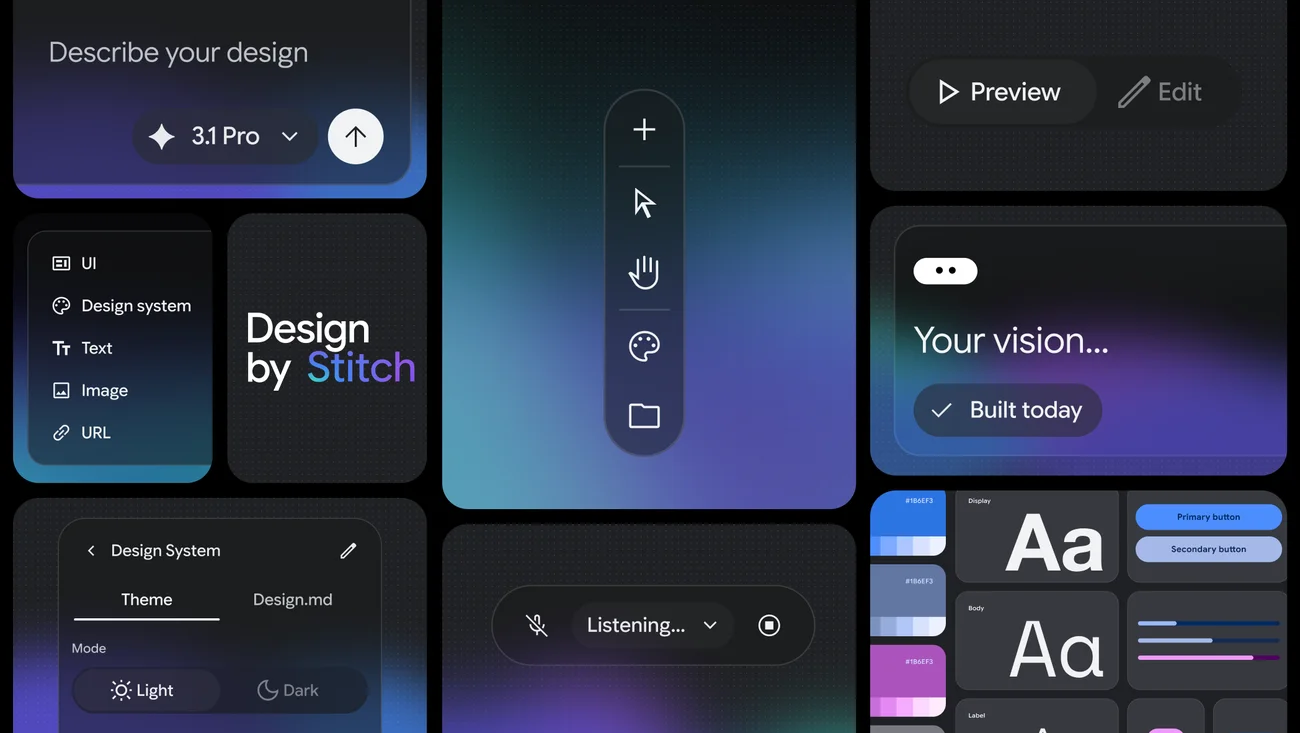
Google Labs is pushing Stitch beyond the category of a simple prompt-to-mockup toy. In its latest update, the product is becoming an AI-native software design canvas built to help people move from rough ideas to high-fidelity user interfaces with less friction.
The timing matters. AI-assisted development has already changed how teams write code, but the early design phase is still a bottleneck for many products. Ideas get captured in documents, sketches, screenshots, and half-finished prototypes, and then they have to be translated again when engineering starts. Stitch is now trying to reduce that translation layer.
Instead of asking users to begin with a wireframe, Google is positioning Stitch as a place to start with intent: a business goal, a mood, an inspiration image, or even code. From there, the tool can help explore layouts, refine interactions, and keep the evolving design in one shared workspace.
From one-shot generation to an ongoing design process
The biggest change is conceptual. Stitch is no longer being framed as a generator that spits out a single design and leaves the rest to the user. It is being reworked as a persistent canvas where ideas can grow, split, and converge over time. That is a meaningful shift because product design rarely happens in a straight line.
Teams usually cycle through multiple directions before they find the right one. A promising concept may need a different navigation pattern, a denser data layout, or a simpler onboarding flow. An AI tool that can keep track of those branches, rather than forcing every new idea into a fresh prompt, is much closer to how real design work actually happens.
Google says the new Stitch UI includes an infinite canvas and a design agent that can reason across the project as it evolves. There is also an Agent manager to help people stay organized when they are exploring multiple directions in parallel. In practice, that means the product is trying to support both divergent brainstorming and structured refinement in the same space.
What the new canvas is meant to solve
For design and product teams, the pain point is not usually lack of ideas. It is keeping momentum while moving from idea to something usable. The new Stitch canvas is built to accept multiple kinds of context at once: text, images, and even code. That matters because the best product decisions often come from combining all three.
A screenshot can show what a competitor already does well. A paragraph can describe the business goal. A code snippet can reveal constraints from the implementation side. By letting those inputs live together, Stitch is trying to keep the product conversation closer to the real source material instead of flattening everything into a single prompt.
That is also why this feels relevant to AI-assisted development, not just AI-generated art or mockups. A canvas that can carry design intent forward is useful when a team is trying to ship software, not merely produce something visually attractive. The more context survives between the first idea and the prototype, the less work gets lost in translation later.
DESIGN.md turns design into something portable
One of the more interesting additions is DESIGN.md, which Google describes as an agent-friendly markdown file for design rules and system context. In plain English, that means design knowledge can become a portable artifact instead of living only inside one tool or one person’s head.
This is an important direction for the broader AI tooling ecosystem. Code already has ways to share structure across tools: repositories, package manifests, lint rules, and config files. Design has historically been much messier. If Stitch can export and import design systems in a lightweight format, teams may be able to preserve visual and interaction rules more reliably as they move between tools.
That could be especially valuable for startups and internal teams that do not have a large design ops function. A small group can define a system once, then reuse it across multiple experiments without rebuilding the same design logic from scratch each time. In other words, DESIGN.md is less about a file format and more about making design state portable.
Why developers should care
Developers often feel the impact of design tools only when they are handed a mockup that is hard to implement. Stitch’s new direction is interesting because it appears to pull developers earlier into the process. If code can be used as context, and if design systems can be exported in a structured way, the gap between prototype and implementation gets smaller.
That does not mean the tool replaces human judgment. It does mean the handoff from product to design to engineering may become more iterative and less ceremonial. Teams could sketch a concept, test flow, adjust the structure, and carry that context into implementation without recreating the same decisions three different times.
For AI-assisted development specifically, this is the kind of workflow change that matters most. The industry has spent a lot of time on code generation, but the real productivity wins often come from reducing coordination overhead. If Stitch helps a team agree on what to build faster, the engineering benefits may be bigger than any single generated screen.
The real test: quality, consistency, and trust
As with most AI design tools, the challenge will be consistency. Generating one good screen is easy compared with maintaining a coherent product experience across many screens, states, and edge cases. The more ambitious Stitch becomes, the more it will need to prove that it can preserve structure without making the interface feel generic.
There is also the usual question of trust. Designers and developers need to know when the tool is a helpful collaborator and when it is taking shortcuts. If Stitch can clearly show what it inferred, what it changed, and how it is applying design-system rules, it will be much easier to adopt in real teams.
- Best-case outcome: faster exploration, clearer handoffs, and less rework.
- Realistic near-term use: early-stage prototypes, internal tools, and rapid experimentation.
- Main risk: polished-looking output that still needs a lot of human correction.
Why this update matters now
Google’s move is a signal that AI product design is maturing. The next phase is not just generating interfaces from prompts; it is preserving intent across a workflow that includes research, design, prototyping, and implementation. Stitch is trying to become the surface where those steps meet.
If it works, the payoff will be less about replacing designers and more about compressing the path from idea to shared artifact. That is a meaningful shift for teams building modern software, especially when speed, iteration, and cross-functional alignment are part of the job.
Stitch still looks like an ambitious Google Labs experiment, but the direction is clear: move past blank-canvas paralysis, keep context alive, and let AI help teams design software the way they actually work.