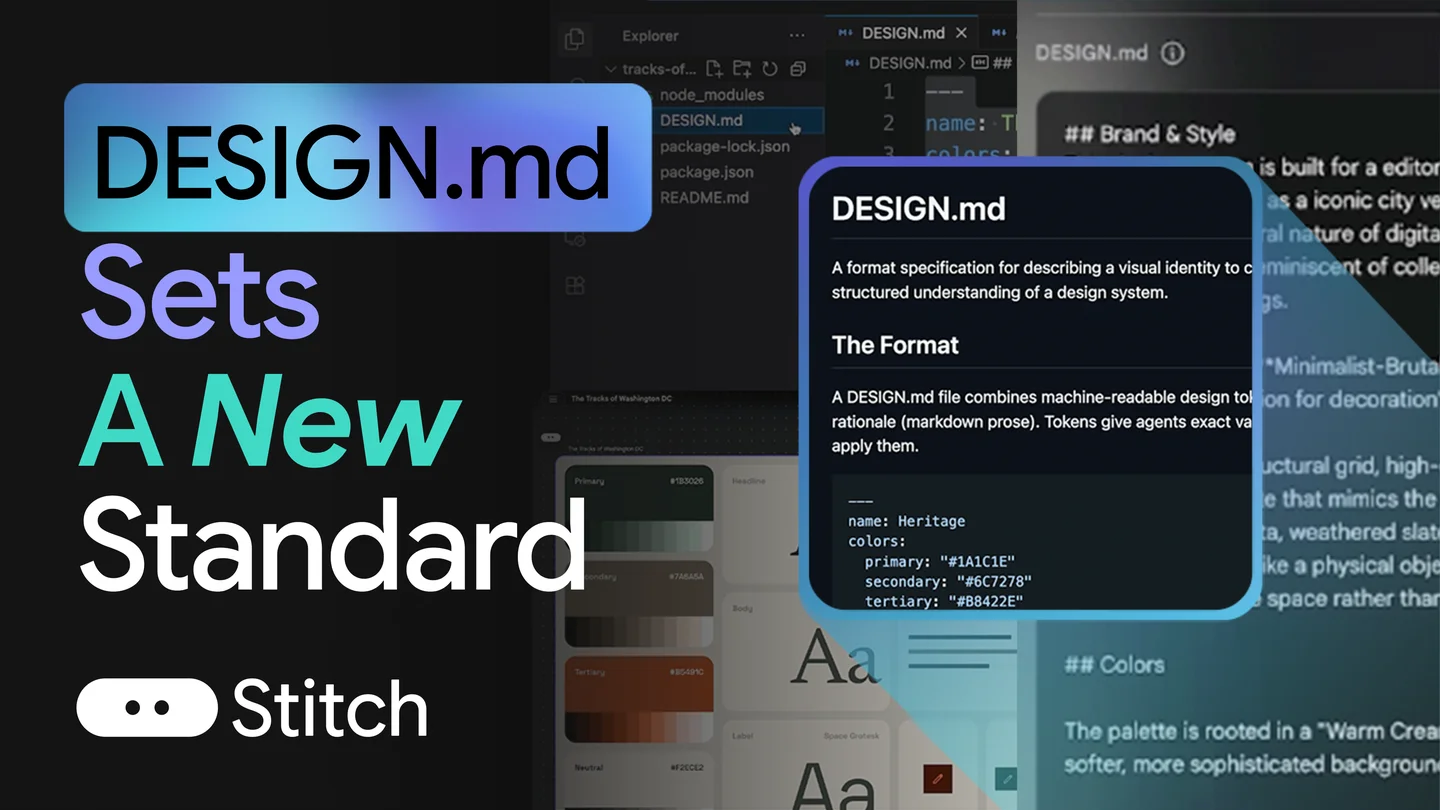
Google Labs has open-sourced the draft DESIGN.md specification that powers Stitch, its AI design canvas. The point is not just to make another file format available on GitHub. It is to preserve design intent in a way that other tools, agents, and teams can actually understand.
That matters because AI-assisted development has started to blur the line between product design and implementation. When a layout, color token, component role, and accessibility rule can travel together in a single markdown-based artifact, the handoff between designers and developers gets a lot less fragile.
In Google’s framing, DESIGN.md gives Stitch a shared visual language. Instead of asking an AI system to infer why a color exists or how a component should behave, the file can encode that context directly. The result is a better chance that generated interfaces stay aligned with a brand system, keep the right semantic structure, and remain accessible as they evolve.
Why this is a meaningful developer story
Most AI UI tools are still optimized for producing a first draft fast. The hard part is everything that comes after: keeping the design coherent, making changes without breaking the system, and moving work between tools without re-creating the same rules over and over. A portable design-spec file addresses exactly that problem.
For development teams, this is especially interesting because it turns part of the design process into something closer to source code. A markdown file can be reviewed, diffed, versioned, and automated. That opens the door to workflows where agents are not merely generating mockups, but working from durable project context that survives tool changes.
What Stitch is trying to solve
Stitch is Google Labs’ experimental AI-native design canvas. The broader pitch is that teams should be able to go from intent to usable UI without spending so much time rebuilding the same decisions in each new tool. DESIGN.md is the connective tissue that makes that possible across platforms.
Google says the spec can help AI agents understand the purpose behind design choices and validate them against accessibility constraints such as WCAG rules. That is a subtle but important shift: the model is not only generating pixels, it is also reasoning over the rules that should govern those pixels.
- Portability: design rules can move between tools instead of being locked inside one editor.
- Consistency: AI systems can reuse the same context rather than guessing on every new screen.
- Accessibility: the spec can capture constraints that help generated interfaces stay usable.
- Iteration: teams can evolve a design system without starting from scratch.
Why it matters now
The bigger trend here is that AI-assisted development is becoming less about one-off prompt tricks and more about workflow infrastructure. The winning tools are the ones that preserve context, make outputs portable, and let humans and agents collaborate without losing the rationale behind the work.
That is what makes this Google Labs move interesting. It is not simply a feature update. It is an attempt to standardize a piece of the AI design loop so that the output of one session can become reusable input for the next one, even in a different tool.
For teams already using AI to prototype interfaces, the lesson is straightforward: the next competitive advantage may come from how well your design intent survives translation. The less context you lose between design, code, and review, the more useful AI becomes as a real production tool.
In other words, Google is treating UI generation less like a magic trick and more like an engineering system. That is the kind of shift that tends to matter long after the announcement fades.