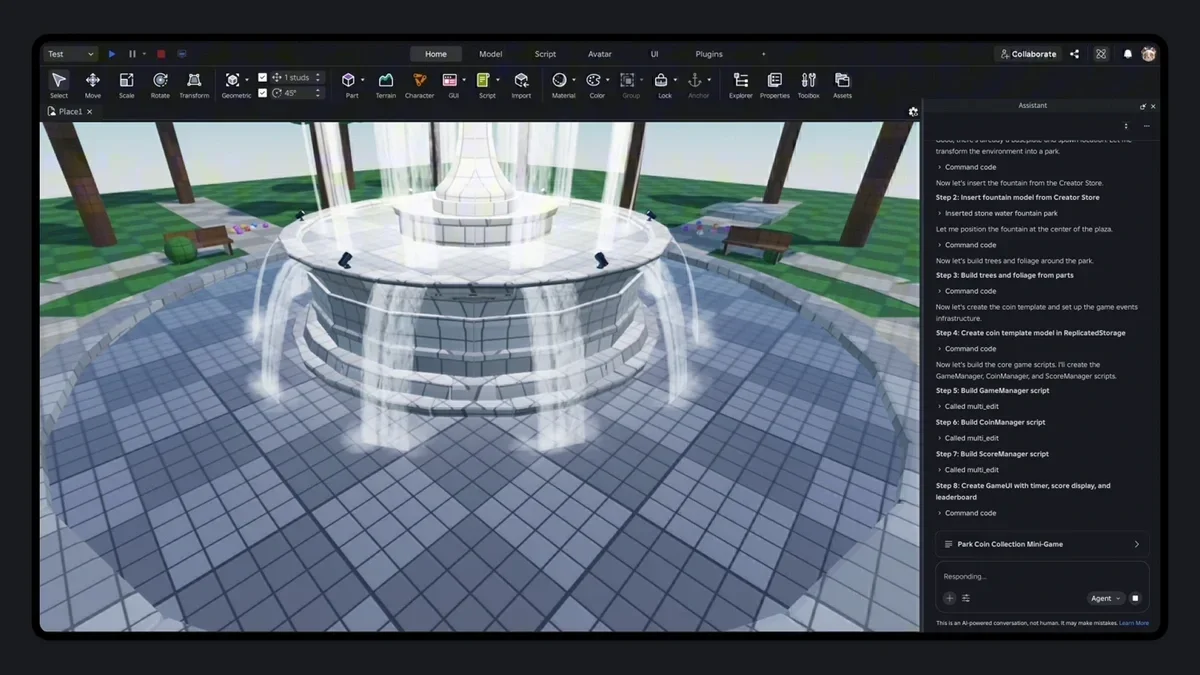
Roblox is no longer treating AI as a single chat box bolted onto a creator workflow. In a new engineering update, the company says Roblox Studio is becoming more agentic: the assistant can help creators plan a project, build assets and systems, and test the result in a tighter loop that looks a lot more like software engineering than prompt-and-pray generation.
That matters because Roblox sits at the intersection of game development, creator tooling, and software automation. The company is not just adding convenience features. It is pushing AI deeper into the steps that determine whether a project ships: scoping the work, making changes to code and data models, and validating behavior before players ever see it.
From one-shot prompts to structured workflows
The headline shift is Planning Mode. Instead of asking a model to immediately rewrite or generate something, creators can have Assistant break a task into a structured plan, ask clarifying questions, and turn a vague request into a reviewable action list. That is a subtle but important change. It acknowledges a reality that every serious team already knows: the hard part of AI-assisted development is not producing text or code fragments, but preserving intent while coordinating many small edits across a project.
Roblox says the new approach lets Assistant analyze code and data model context, then produce an editable plan before making changes. In practical terms, that is closer to an engineering design review than to autocomplete. It is the same direction the broader AI coding market is moving in, but Roblox is applying it to a world where the output is interactive, visual, and performance-sensitive.
Building is becoming more than asset generation
The second piece is the build phase. Roblox is adding Mesh Generation and preparing procedural model tools that can be controlled by code and prompts. The immediate promise is faster world-building. The bigger implication is that AI is starting to describe, assemble, and refine reusable building blocks instead of only drafting source text.
That distinction matters for developers because game creation blends code, data, art, and behavior. A model that can help create a mesh, then expose attributes that a creator can adjust later, is not just generating content; it is participating in the structure of the application. For studios and independent developers alike, that could reduce the friction between “idea” and “implementable system.”
Testing is where the signal gets strongest
The most software-like part of the announcement is the new playtesting agent beta. Roblox says the agent can read logs, inspect the code and data model, and use the player character as an automated QA tester. That moves AI-assisted development into a phase many teams still struggle to automate well: verification.
AI tools have spent much of the last two years helping developers draft code faster. But drafting was never the bottleneck by itself. The bottleneck is understanding what changed, whether the change broke something else, and whether the result still matches the original plan. By framing playtesting as part of the loop, Roblox is leaning into a more mature idea of AI in software development: not a replacement for engineering judgment, but a system that can continuously observe, propose, test, and revise.
A broader developer-tooling story, not just a gaming story
Roblox is also making an architectural bet by exposing more context to third-party tools through its built-in MCP server. The company says creators should be able to use tools such as Claude, Cursor, and Codex with Studio. That is important because it turns the platform into a hub instead of a closed environment. The AI assistant is no longer the only path into the workflow; it becomes one layer in a larger toolchain.
That is a pattern worth watching across the software industry. The winning tools are increasingly the ones that can sit inside existing developer habits rather than force a single interface. If AI is going to become part of daily engineering practice, it has to interoperate with the IDE, the repo, the test harness, the asset pipeline, and the project context. Roblox’s approach suggests that even consumer-facing creator platforms are now designing for that reality.
Why this matters beyond Roblox
Most AI coding headlines still focus on model launches, pricing changes, or enterprise deployments. Those are important, but they can obscure the more practical shift happening inside development teams: AI is moving from a helper that writes snippets to a collaborator that participates in an end-to-end workflow.
Roblox Studio going agentic is a strong example of that transition. It shows how a product can combine planning, generation, testing, and tool interoperability into one system. It also shows how the language of software development is changing. Terms like plan, build, test, context, and review are becoming the vocabulary of AI product design, not just engineering process.
For developers, the lesson is straightforward. The next wave of AI tooling will be judged less by how clever it sounds in a demo and more by how well it preserves intent, handles context, and fits into the systems teams already use. Roblox is betting that creators want fewer magical shortcuts and more reliable loops. That is probably the right bet.