AWS is pushing Kiro, its agentic coding tool, in a direction that feels bigger than a feature refresh. The company has added parallel task execution, a faster planning path for well-understood work, and a requirements-analysis step that tries to catch problems before code is written. The practical effect is simple: Kiro is moving from a prompt-first helper toward a specification-first development system.
That shift matters because a large part of software work is not typing code. It is clarifying scope, separating independent work, understanding dependencies, and making sure an implementation still matches the original intent after the first draft. Kiro’s new workflow is built around that reality. Rather than treating a short prompt as the full plan, it creates a set of structured artifacts that guide the agent as the work unfolds.
What AWS changed
The most visible update is parallel task execution. When a feature can be broken into independent pieces, Kiro now analyzes the task list and runs compatible work in parallel instead of forcing every step through a single queue. That is a meaningful upgrade for larger projects, where one linear chain can waste time even when the work naturally branches.
The second change is a faster planning flow for tasks that are already well understood. Instead of making users step through every stage in the same way, Kiro can ask a small set of focused questions up front, then move straight into requirements, design, and implementation artifacts when the scope is clear. In other words, the tool is trying to spend more time where ambiguity exists and less time where the path is obvious.
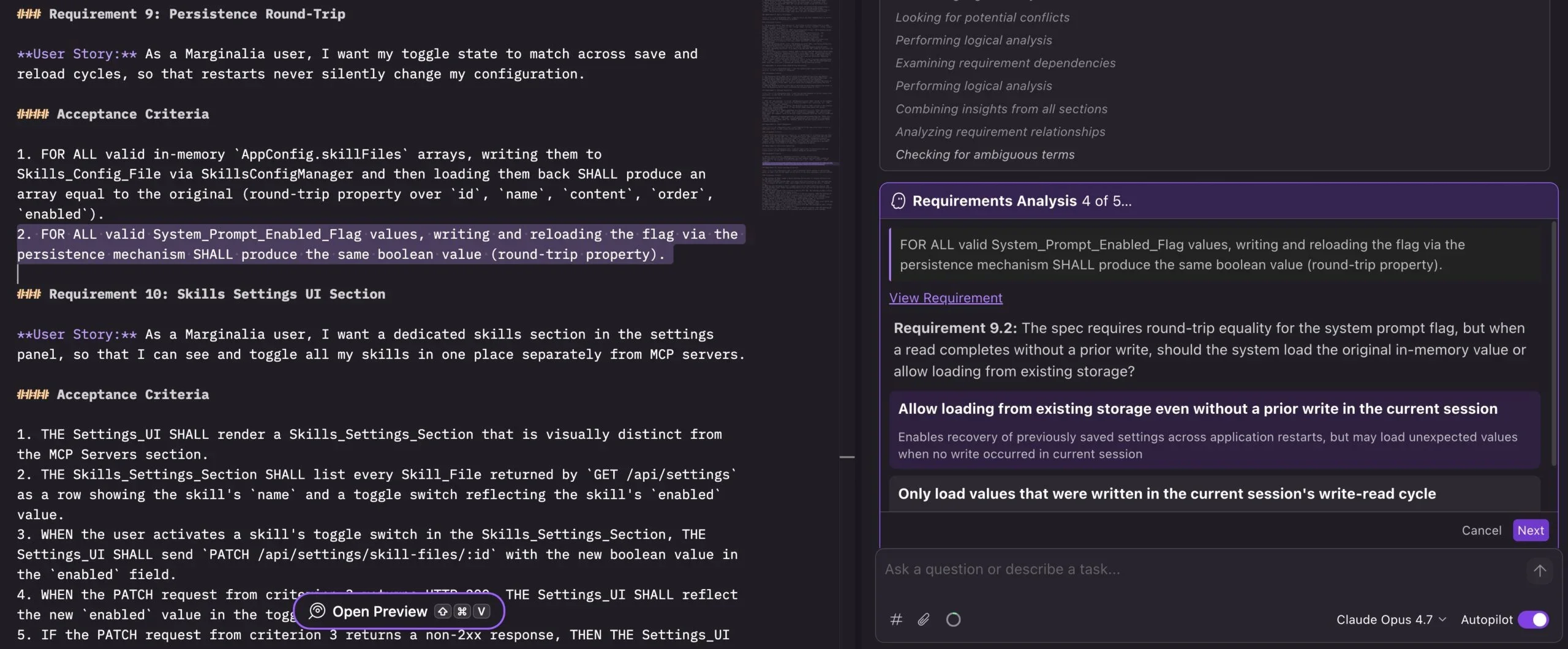
The third addition is requirements analysis. Before the first line of code is produced, Kiro can examine the project’s stated requirements for conflicts, gaps, or unrealistic assumptions. That is the most interesting part of the update, because it moves AI assistance closer to the part of software development that usually causes the most rework: deciding whether the thing being built actually makes sense.
Why this is a developer story, not just an AI story
Most AI coding tools still compete on how quickly they can produce a plausible answer. AWS is making a different argument. It is suggesting that the next leap in AI-assisted development will come from coordination, not just generation. If an agent can understand dependencies, separate independent work, and preserve a written plan, it can do more than autocomplete. It can help run a project.
That also changes how teams may evaluate these systems. The question is no longer only whether a model can produce decent code. It is whether the surrounding workflow can keep the work coherent as it grows. Can the agent handle multiple branches without stepping on itself? Can it keep the plan aligned with the implementation? Can it surface contradictions before they become expensive? Those are the questions AWS is now trying to answer inside Kiro.
There is a clear enterprise angle here. Structured artifacts create a record of why a feature exists, how it is meant to behave, and what assumptions were made along the way. That gives engineering leaders something they can review, edit, and govern, rather than relying on a chain of opaque prompts. For teams worried about scale, compliance, or handoffs, that matters as much as raw coding speed.
The broader signal
Kiro is also a sign that AI-assisted development is converging with older ideas from software process discipline. The industry spent years debating prompts, copilots, and autonomous agents as if they were separate categories. AWS is blending them. The interface is conversational, but the execution is structured. The idea is natural language in, tracked implementation out.
That approach may not be ideal for every task. Very small changes do not need a full specification flow, and highly exploratory work can still benefit from loose, open-ended iteration. But for features with dependencies, team ownership, or real operational risk, a specification-driven workflow can be more useful than a blank chat box. It gives the agent a shape to follow and gives the team a way to inspect the shape before it turns into code.
Seen that way, AWS is not just adding convenience to Kiro. It is betting that the future of AI coding will be judged by whether the agent can help people build with fewer surprises. Faster generation matters, but reliable orchestration matters more once software stops being a toy and starts becoming a system. That is the direction Kiro is pointing in now.