Poolside’s latest release is a useful reminder that the center of gravity in AI-assisted development is moving again. Not just toward better autocomplete, and not just toward bigger closed models, but toward tools that developers can actually run, inspect, and adapt.
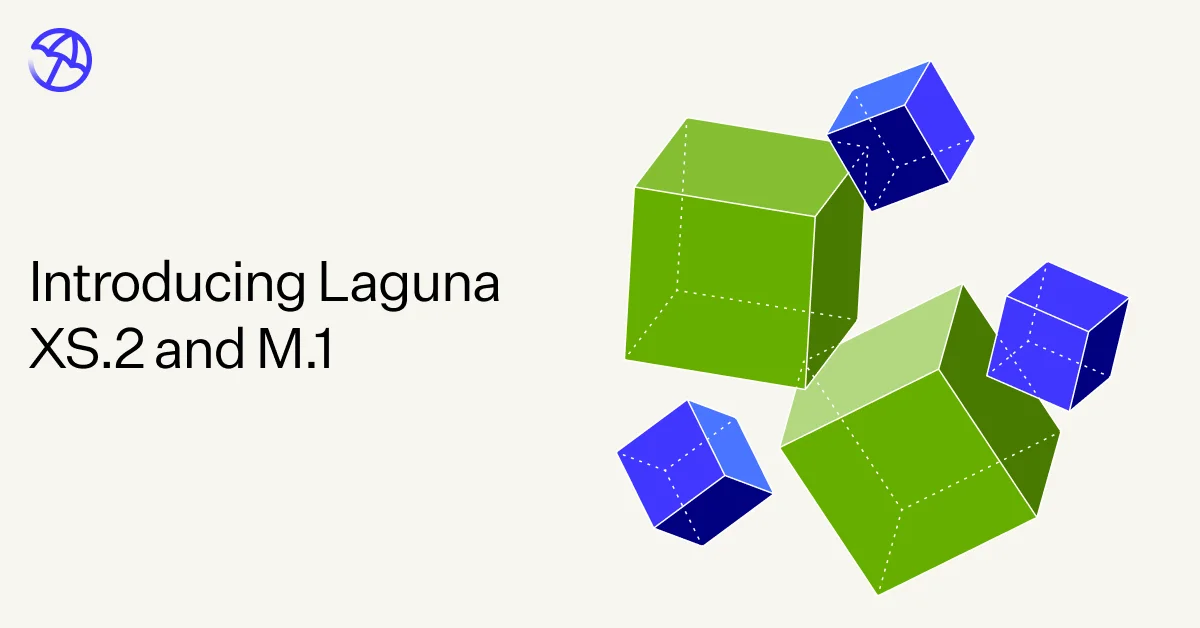
On April 28, Poolside said it was releasing two foundation models and two products focused on agentic coding. The headline model for many teams will be Laguna XS.2: a 33B-parameter open-weight release with 3B active parameters, published under Apache 2.0. Poolside says it is small enough to run on a single GPU, which makes it interesting for teams that care about latency, local workflows, or tighter control over source code and prompts.
That matters because the conversation around coding assistants has shifted. Early tools were mostly autocomplete with a chatbot attached. The next wave has been about agents that can plan, edit, test, and keep working across a longer task. The challenge is that those systems are often expensive, opaque, or tightly coupled to a vendor’s cloud. Open weights change that equation. They do not magically make a model good, but they do make it much easier to evaluate, deploy, and integrate into real engineering stacks.
What Poolside is actually shipping
Poolside is not only releasing models. It is also bundling them into products: pool, a terminal-based coding agent, and Shimmer, a cloud development environment aimed at building web apps, APIs, and CLIs with the company’s models.
That product packaging is the most interesting part of the announcement. Many AI-code launches stop at “here is a benchmark chart.” Poolside is trying to tell a more complete story: model, runtime, and workflow. In other words, it is not just selling a model; it is trying to own the loop from prompt to patch to test to iteration.
Poolside also says Laguna M.1, its larger 225B model with 23B active parameters, is being made publicly available. If XS.2 is the practical, deployable option, M.1 is the flagship that signals where the company wants the frontier to go: longer-horizon coding work, more agentic behavior, and a system designed around software tasks rather than generic chat.
Why open weights matter for developers
- Local control: Teams can run experiments without sending everything to a hosted endpoint.
- Custom evaluation: Engineering orgs can test the model on their own repos, tools, and failure modes.
- Better integration: Open-weight models can be wrapped into internal assistants, CI workflows, and code-review pipelines.
- Lower friction for prototyping: A smaller model that fits on a single GPU is easier to spin up for trials, demos, and private environments.
That does not mean every team should rip out its current stack and replace it with an open-weight coding model tomorrow. Coding quality, tool use, and long-horizon reliability still matter more than a release note. But open weights give engineering teams something they have wanted for a while: a way to participate in the agentic-coding trend without depending entirely on a black-box SaaS experience.
The strategic read
Poolside’s release is part of a broader market shift. The most important AI-code products are no longer trying to look like smarter autocomplete. They are increasingly trying to behave like software collaborators: agents that can follow a task, keep state, and make progress over multiple steps.
By shipping an open-weight model alongside a terminal agent and a cloud dev environment, Poolside is making a different bet from the companies focused on purely hosted copilots. It is betting that developers want choice. Some teams will want a hosted agent with guardrails. Others will want a model they can run locally, inspect more deeply, and wire into their own infrastructure. XS.2 is designed to speak to that second group.
The other thing to watch is whether the open-weight angle produces a real ecosystem. If developers start building internal tools, agent scaffolds, and evaluation harnesses around Laguna XS.2, the release could matter well beyond one product launch. If not, it will still be a useful data point in the market’s race to make coding agents more practical, but less closed.
For now, the key takeaway is simple: Poolside is trying to push AI-assisted development one layer lower in the stack. Instead of asking developers to trust a remote assistant, it is offering a model and workflow they can shape themselves.