Epic Games opened the Preview of its new launcher on October 14, 2026, for Windows, macOS and, for the first time, Linux. Behind the redesigned interface and promises of greater responsiveness, the company describes a development effort extensively supported by AI agents. The fuller account, however, is not about software appearing without developers. It is about a team delegating implementation while retaining control of the process and its outcome.
That distinction makes this rewrite relevant to software teams beyond gaming. Agents contributed to writing and reviewing code, as well as testing. People remained responsible for managing the work and supervising the entire effort. The headline phrase is provocative; the engineering arrangement underneath it deserves a more careful reading than the slogan alone allows.
A provocative opening, a supervised project
The official announcement begins with a joke: “Programming is hard.” Epic then says it “vibe coded” a new launcher. Taken literally, that introduction could obscure the explanation offered by Martin Keely, vice president and general manager of the Epic Games Store and Epic Online Services, in interviews about the project.
Speaking to IGN, Keely describes AI as a tool within the development process. He says it made a small team more efficient, helped it rewrite the codebase and enabled a faster launch across platforms. His explanation focuses on code efficiency, architecture and building features more quickly, rather than claiming that every part of the product was generated automatically.
Keely tells The Verge that agents wrote and reviewed the code, and that AI was particularly helpful for testing and reproducing the existing launcher’s core functionality. The development team managed the process and supervised the entirety of the work. Epic had been working on the launcher for most of the year: this was not an application assembled in a few days following a new corporate announcement.
Different AI policies are not interchangeable
Those statements do not establish that the launcher’s developers were forbidden from writing code themselves. Keely explicitly distinguishes this team’s approach from the “no more hand-written code” policy reported in connection with another Epic project. Applying that policy to the launcher would turn contextual reporting into an unsupported claim about its engineering rules.
The same caution applies to model attribution. The sources consulted do not identify a particular large language model as the engine behind this rewrite. Reports about Claude being used elsewhere within the company do not establish which model powered the launcher project. There is no basis here for crediting a specific provider, product tier or model version with this application.
Nor should the new visual style automatically be described as AI-generated. Keely tells IGN that updates to the artwork and design style were managed by Epic Games’ regular design group. Assistance with code and architecture does not, by itself, establish how the visual assets or interface design were produced.
What players actually get in the Preview
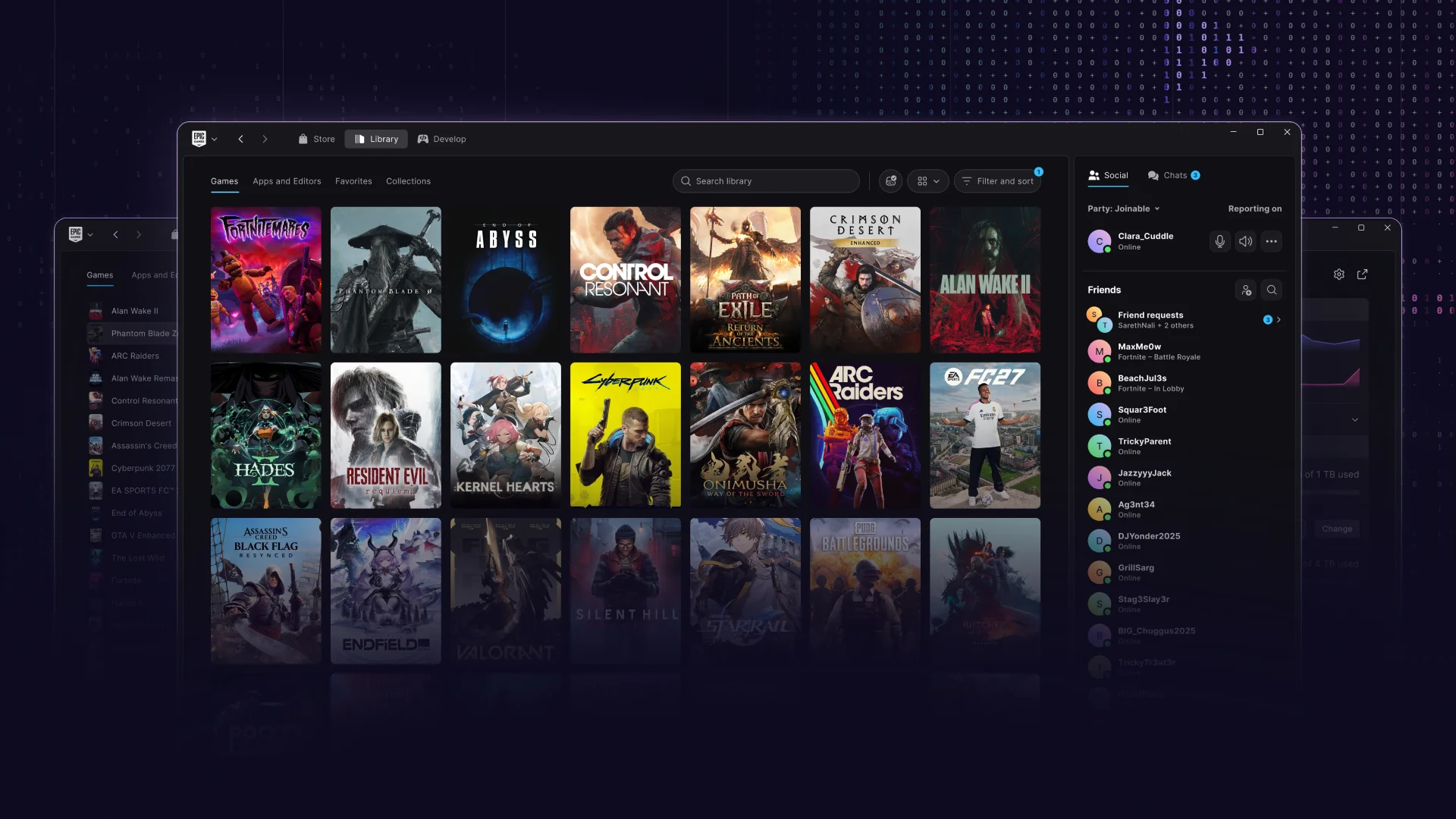
Epic promises faster cold starts, more responsive navigation between the store and library, and less system load while the launcher runs in the background. These are the company’s claims, not findings from an independent benchmark conducted for this article. Their practical significance will depend on performance across representative computers, operating systems and game libraries.
The refresh also targets everyday tasks rather than speed alone:
- A dedicated page for each game brings together its status, activity, details and launch controls.
- Collections, grid and list views, and a customizable top bar offer different ways to organize the library.
- Search and filtering update while the user types, helping people navigate larger collections.
- Download management displays download, read and write speeds, alongside active, queued, scheduled and failed transfers.
- Social features and voice chat connect friends across several parts of Epic’s ecosystem.
This first release remains deliberately light on features. The old launcher is still available, and Epic has not announced a specific deadline by which everyone must migrate. Keely says the full launch depends on stability and parity wherever the company needs it. Keeping the previous version available matters: a rewrite cannot be assessed solely by how fresh its interface looks.
For teams considering similar migrations, that distinction is useful. A promising Preview is evidence that a new implementation can be tried, not proof that every existing workflow has already been replaced. The appropriate question is which requirements the release meets today, and which remain on the roadmap.
A Linux launcher is not yet Fortnite on Linux
Linux support for the launcher is a concrete addition, but it does not make Fortnite immediately playable on Linux. Epic says it is rebuilding Easy Anti-Cheat and working with distribution maintainers on security requirements. Fortnite’s arrival depends on that infrastructure working with a sufficient number of distributions, rather than simply on the launcher installer becoming available.
This separation illustrates a familiar limit of automation. Porting a client application does not automatically resolve the dependencies of the surrounding ecosystem. Game compatibility, anti-cheat protections and platform security requirements remain distinct workstreams. The launcher release and the Fortnite roadmap should therefore not be merged into a single availability claim.
Our analysis: delegate execution, specify the contract
The following lessons are our analysis, not a description of an internal procedure disclosed by Epic. A migration of this kind benefits from an explicit functional contract: which behaviors must remain intact, which differences are acceptable, and which failures should block release. Reproducing an established application means preserving important behavior, not merely rebuilding familiar screens.
A team might separately verify authentication, recognition of installed games, interrupted downloads, updates and preservation of settings. These are examples of possible migration criteria; they are not a claim about Epic’s private test inventory. Their value is that they turn a broad instruction to replicate functionality into outcomes that can actually be checked.
Agent review should not be mistaken for independent evidence of correctness. Regression tests, targeted human validation and reproducible measurements can complement AI-assisted implementation and review. Agreement between automated contributors is useful information, but the release decision still needs evidence tied to the product’s requirements and the risks faced by users.
It is equally important to separate two promises: building software faster and building software that runs faster. The first concerns the team’s development process; the second concerns the user’s experience. Shorter implementation cycles do not automatically establish better runtime performance, and a responsive interface does not reveal how much supervision its creation required.
Epic’s launcher therefore demonstrates neither the disappearance of developers nor a universal recipe for AI development. It presents an ambitious use of agents within a supervised rewrite that is still in Preview. The most defensible lesson is straightforward: a team can delegate substantial amounts of code without delegating responsibility for the product it ships.