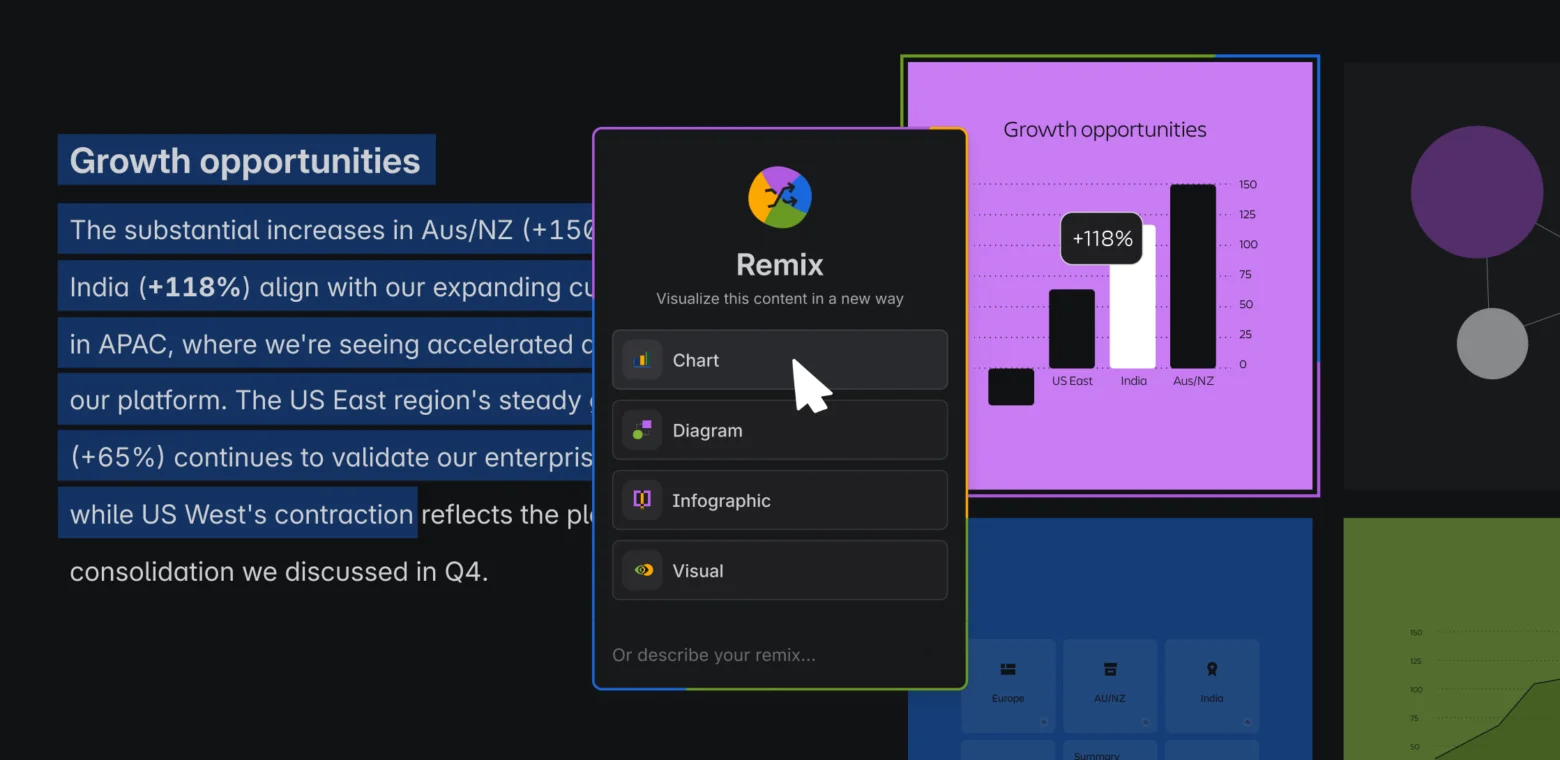
Atlassian’s latest Confluence update is a good snapshot of where enterprise AI is headed: not just toward faster drafting, but toward turning the docs teams already have into the next artifact they need. With Remix with Rovo and new partner agents for Lovable, Replit, and Gamma, Confluence is being positioned less like a static knowledge base and more like a workflow engine for the handoff between ideas, visuals, and working software.
The headline feature is Remix with Rovo, which is rolling out in open beta for Confluence Cloud customers. According to Atlassian, users can select content on a page and instantly transform it into a chart, infographic, diagram, or other visual format. The point is not merely to make a page prettier. The company’s argument is that a lot of important knowledge is trapped in the wrong format, and that format friction is what slows teams down.
That is a meaningful shift for developer teams. In practice, engineering work rarely stops at the text in a document. A product spec becomes a design review. A design review becomes a prototype. A technical brief becomes a task list, then a ticket, then a starter app or a demo. Every one of those transitions usually requires copy-paste work, reformatting, and context switching. Atlassian is betting that Confluence can absorb some of that overhead directly.
From pages to deliverables
What makes the announcement interesting is that Atlassian is not framing AI as a general-purpose chatbot bolted onto the side of a page editor. It is treating the page itself as a reusable source of truth. Remix can turn a dense section into a chart or a visual summary without overwriting the original page. That matters because teams need the canonical document to stay intact while still producing derivatives for different audiences.
That same idea extends to the partner agents. Atlassian says it is shipping out-of-the-box agents for Lovable, Replit, and Gamma, built on Rovo and powered by MCP. From a workflow perspective, the promise is simple: a spec on a Confluence page can become a working prototype in Lovable, a starter app in Replit, or a presentation in Gamma without hand-building the bridge each time.
For software teams, that is more than a novelty. It pushes AI closer to the point where a document is not just something you read before shipping code, but something that can actively produce the first draft of the next step. That could shorten the cycle from planning to experimentation, especially for teams that already use Confluence as the place where product, engineering, and design decisions live together.
Why this matters for AI-assisted development
Most of the attention in AI-assisted development has gone to code generation, code review, and agentic coding. Those are still the flashiest parts of the market. But the real bottleneck in many teams is not the first line of generated code. It is the transition from messy human context to something structured enough for an agent, a designer, or a developer to act on.
That is where Atlassian’s update is strategically important. The company is leaning into the part of the workflow that sits upstream of the editor: deciding what a team is building, how to explain it, and which format is most useful at each step. If AI can reliably turn a product page into a chart, a prototype, or a slide deck, it becomes easier to keep momentum across functions without asking everyone to re-create the same idea in a new tool.
Atlassian also says the partner agents inherit workspace permissions and context through its Teamwork Graph and Rovo layer. In theory, that reduces one of the biggest enterprise objections to AI workflow tools: the fear that useful context gets detached from the source material and copied into a third-party app with unclear governance. If the agent is actually permission-aware and linked back to the original page, the output can stay closer to the corporate record.
The governance question teams will still have to answer
Even if the features work as advertised, they create new questions for engineering and IT leaders. Who can enable the partner agents? Which pages are safe to remix into external tools? What should happen when a prototype built from a Confluence page moves faster than the source documentation? And how should teams audit changes once AI starts generating derivative artifacts from a canonical page?
Those questions matter because AI-assisted development is increasingly a systems problem, not just a model problem. The value of a feature like Remix depends on access controls, trust boundaries, and review practices. If a team can create a chart or starter app in one click but cannot tell where the content came from, what permissions applied, or how to roll back bad output, the productivity win may be smaller than it looks.
That is why Atlassian’s emphasis on keeping Remix non-destructive is smart. The original page remains intact, and the visual output is layered on top. That design choice suggests the company understands that teams need both speed and accountability. The goal is not to replace the source of truth; it is to make the source of truth more adaptable.
The bigger trend: AI is moving into the workflow layer
The Confluence update fits a broader pattern across enterprise software. AI is no longer being sold only as a writing assistant or a code assistant. It is becoming a workflow layer that can translate between formats, between tools, and between roles. That is why the integration list matters as much as the model itself. Lovable, Replit, and Gamma are not random partners; they represent the kinds of downstream artifacts teams actually need after the first draft is written.
For developers, the practical takeaway is that AI tools are starting to compete on orchestration, not just generation. The best product may not be the one that writes the most code or the most text. It may be the one that turns a single page into the right next artifact with the least friction. That is a more subtle proposition, but it is also more defensible for enterprise buyers.
TechCrunch reported that Atlassian’s announcement sits alongside its broader push to place AI agents directly inside the apps workers already use, rather than creating yet another standalone platform. That approach is likely where the market is heading. Teams do not want five different AI surfaces. They want the AI to show up where the work already lives.
If Atlassian’s bet works, Confluence will become more than a repository for meetings and specs. It will become a launchpad: a place where a paragraph can become a chart, a roadmap can become a prototype, and a technical note can become a starter app. That may sound modest compared with the hype around autonomous coding agents, but it solves a problem most teams feel every day — the gap between ideas and the formats required to move them forward.
In other words, the next productivity gain may not come from generating more content. It may come from turning the content teams already trust into the exact artifact they need next.
For engineering leaders, the question is whether that promise shows up as real throughput or just more AI-generated noise. The answer will depend less on the demo and more on whether teams can trust the outputs, govern the handoffs, and keep the original documentation clean. That is the real test for any AI-assisted workflow tool now, and Atlassian is staking a clear claim that Confluence should sit in the center of it.